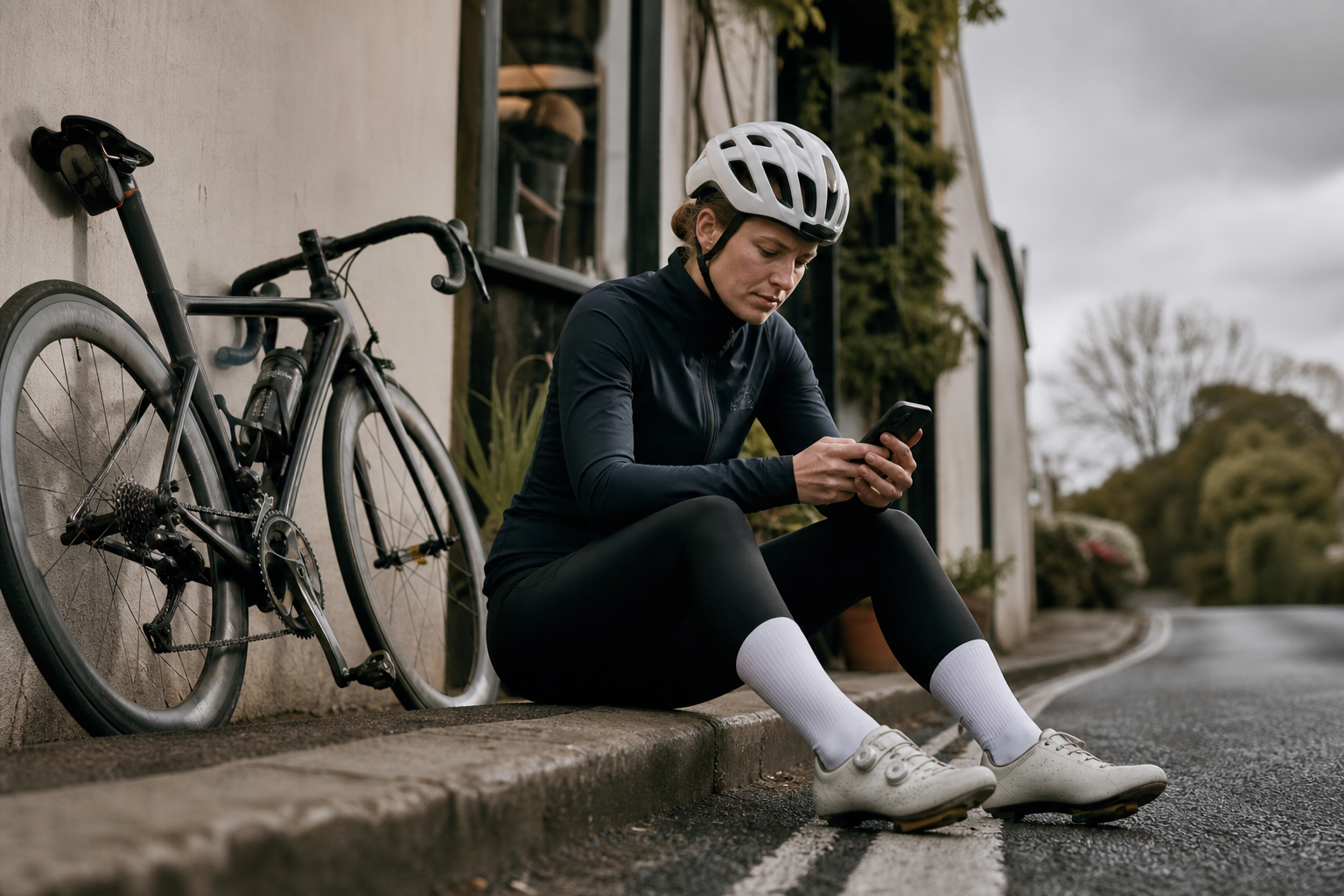
Somewhere on r/TrainerRoad right now, someone is asking whether they should just trust the algorithm.
Somewhere on r/Velo, someone else is posting a screenshot of their FTP dropping 30 watts overnight and asking what they did wrong.
Neither of these are edge cases. We read through dozens of threads on r/TrainerRoad, r/Velo, r/cycling and r/Zwift — the actual public conversation cyclists are having about algorithmic coaching — and the same handful of questions kept showing up, worded differently by different people who have clearly never spoken to each other.
That is a useful signal. When strangers keep arriving at the same worry independently, it is not a personality quirk. It is the product category.
So here is what riders actually say, in their own words, about handing their training over to an AI.
”Should I just trust the AI no matter what?”
That is a direct quote, and it might be the single most common sentence in the entire corpus.
Not “is this app good.” Not “does this app have enough workout variety.” Just: should I trust it.
That question would not exist if riders had already decided the answer was yes. Every rider using an algorithmic coach is running a live experiment on themselves, and they know it. They are handing over a decision — what to do today, on the bike, with their body — to something that cannot see their life.
You already know that feeling if you have ever opened a plan and thought “this looks hard” without being totally sure if hard was the point or a mistake.
Trust is earned one prediction at a time
The clearest pattern in the research: cyclists do not trust an AI coach because of a landing page.
They trust it because it predicted something correctly.
One rider ran a 20-minute FTP test after their platform had estimated their number without a formal test. The result came back 6 watts higher than the estimate. Their comment: “which is close enough for me to not question it anymore.”
Six watts. That is the entire trust transaction. Close enough, on one test, and the algorithm earns the benefit of the doubt for months.
It goes the other way just as fast. One rider described their FTP getting recalculated from 204 watts down to 176 after an update, with almost no recovery afterward. Their words: “this is so confusing.”
Confusing is doing a lot of work in that sentence. Not “wrong.” Not even “unfair.” Confusing — because nobody explained why, and a 28-watt overnight drop with no story attached does not feel like coaching. It feels like a glitch that happens to control your training plan.
This is the part worth sitting with if you are evaluating any AI cycling coach, including ours: the algorithm is not being judged on whether it is technically sophisticated. It is being judged, workout by workout, on whether it was right about you last time.
Opacity breaks trust faster than difficulty does
Here is the finding that actually surprised us going in.
You would assume the biggest complaint about algorithmic coaching is that the workouts are too hard. It is not.
The biggest complaint is not understanding why a decision was made.
Riders will grind through a brutal interval session without much complaint if they understand the logic behind it. What breaks trust is the plan doing something inexplicable — cancelling a key session, dropping a number, changing a whole week — with no visible reasoning attached.
One rider, describing their platform’s AI assistant by its internal nickname the way you’d talk about a slightly unreliable coworker: “Not sure Chad runs the AI but yeah… what even are those workouts??”
That is not anger at difficulty. That is confusion about intent. A hard session you understand is a Tuesday. A hard session you don’t understand is a reason to close the app and go for a normal ride instead.
This matches something almost every rider already knows intuitively: you can absorb a lot of unpleasant news from a coach, as long as the coach explains why. What you cannot absorb is unexplained news from a spreadsheet.
”It’s just a template” is the actual objection
If you want the single sentence that best captures rider skepticism about AI coaching, it’s this one:
“It’s honestly quite dispiriting to think that I might be committing hundreds of dollars a month to someone who is just using AI tools rather than their own personality/knowledge to provide what I need.”
Read that again. The objection is not “AI is bad at training science.” Plenty of riders think the opposite — that the math is probably fine.
The objection is that a template dressed up as personal coaching feels like a small betrayal. You are paying, and behaving, as if something is watching you specifically. The moment it feels like it’s pattern-matching a generic rider profile instead of responding to you, the whole relationship curdles, even if the workouts prescribed were reasonable.
This shows up constantly as a comparison to human coaching, and not always in the AI’s favor: “A coach that needs to rely on AI to communicate with their athletes isn’t a coach worth paying, in my opinion.” Ouch. But also: fair, if that coach never earns your trust the way the good ones do.
The riders who are happiest with algorithmic coaching are not the ones who found the smartest algorithm. They are the ones who stopped feeling like the app was guessing about a stranger and started feeling like it was actually tracking them.
People want an override, and then feel guilty for using it
This one is almost funny, in the way most true things about self-discipline are almost funny.
Riders compulsively toggle their platform’s auto-adjustment setting on and off, wrestling back manual control when a suggestion feels wrong, and then immediately second-guess themselves for having broken the system they are paying for.
“This is where I ignore the software and program in some of my own stuff” — said slightly sheepishly, like a confession.
You know this feeling if you have ever skipped a rest day the plan gave you because you felt fine, and then spent the whole next session waiting for the fatigue-based punishment you were sure was coming.
The pattern underneath this: riders do not want obedience from their coach, human or algorithmic. They want permission. Specifically, permission to trust their own body without it counting as cheating on the plan.
That is a completely different product requirement than “more accurate workout prescriptions.” It is an emotional one. And it is the one most AI coaching marketing skips straight past, because “gives you permission to trust yourself” does not fit neatly into a features list.
The thing nobody asks for, and the thing everybody needs
Across every thread, nobody asked for a smarter algorithm.
Nobody wrote “I wish the AI had a better model of my mitochondrial adaptation.” That is not a complaint that shows up even once.
What people ask for, over and over, in different words, is reassurance.
“A coach can tell you things not to worry about. You don’t know what you don’t know.”
“I’d love to have someone I could reach out to with questions and be confident the response is accurate.”
That second one is worth noticing closely, because it is not really about accuracy. It is about confidence in the accuracy. Those are different things, and riders are pretty clear-eyed about the gap between them.
This lines up with something we believe pretty strongly here: the job of an AI cycling coach is not to be impressively intelligent. It is to leave you confident that today’s session is the right one, that yesterday’s missed workout is recoverable, and that you are allowed to stop worrying about the numbers between sessions.
Riders are not shopping for a smarter machine. They are shopping for the feeling of not having to double-guess themselves every time they clip in.
What this means if you’re actually choosing an AI coach
If you take one thing from a stack of Reddit threads, take this: judge an AI cycling coach the same way its existing users clearly do, whether they realize it or not.
Ask whether it explains itself. Not just what today’s workout is, but why — especially when it changes something. Opacity is what kills trust fastest, faster than a workout that turns out to be too hard.
Ask what happens when you disagree with it. Can you override a session without the app treating you like you broke something? Being able to trust your own body on a good day, or a bad one, should not feel like cheating on your training.
And ask, honestly, whether it is responding to you or pattern-matching a generic rider. The “template, not me” feeling is the single fastest way trust evaporates, and it happens even when the actual workouts are perfectly reasonable.
None of this is really about artificial intelligence. It never was. It’s about whether the system you’re trusting with your training earns that trust the way any good coach does — by being right often enough, and honest about it when it isn’t.
That is the same standard we hold ourselves to. Not “AI-powered.” Just: did today’s plan leave you more confident than yesterday’s did.
If you’ve been reading Reddit threads at 11pm trying to decide whether to trust an algorithm with your FTP, you already know the answer isn’t “trust it blindly.” It’s “trust it once it’s earned it.” Streeka is built around that same idea — a plan that explains itself, adapts to your actual week, and is more interested in getting you to the start line confident than in looking clever while it does it.