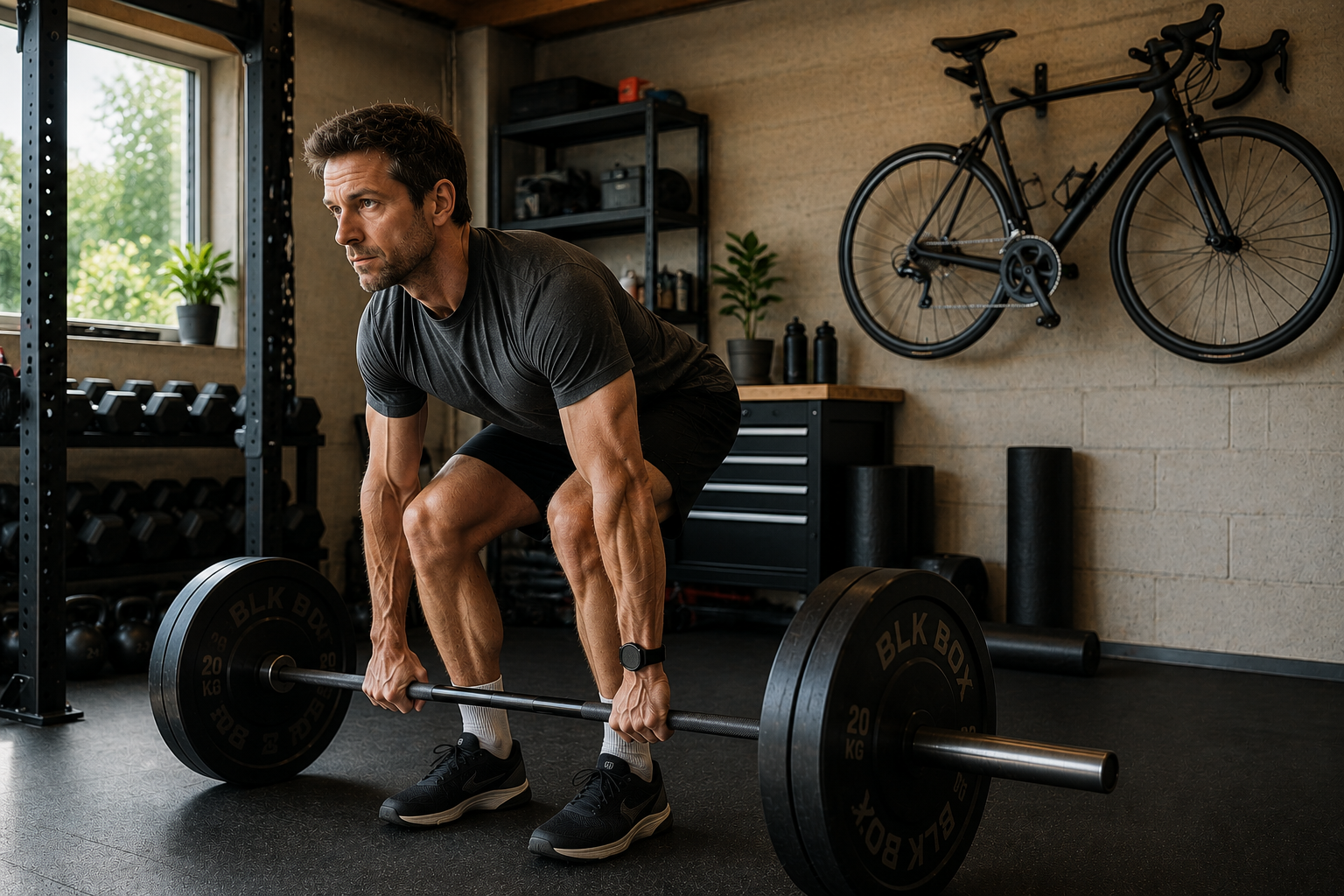
Yes - most cyclists should do some strength training.
Not because you need to become a gym goblin with a shaker bottle and a frightening relationship with chicken breast. Because cycling is repetitive, life is messy, bodies are annoying, and getting stronger can make you a more durable athlete.
The better question is not:
“Should cyclists lift weights?”
It is:
“How do I add strength training without ruining my riding?”
Because that is where most cyclists get it wrong.
They either avoid the gym completely because “cycling is my leg day”, which is a sentence that should probably be taken away from people, or they go too hard, too soon, then wonder why their interval session feels like pedalling through wet cement.
Strength training can help. But it needs to fit into the whole system.
Why strength training matters for cyclists
Cycling fitness is not just about your engine.
Your aerobic fitness matters, obviously. Your FTP matters. Your ability to sit at tempo without quietly bargaining with the universe matters.
But your body also has to support all that work.
Strength training can help cyclists improve:
- muscular durability
- force production
- injury resilience
- posture and control on the bike
- sprinting and climbing ability
- tolerance for repeated hard efforts
- general robustness as training load increases
That last point matters more than people realise.
A lot of amateur cyclists do not fail because they lack motivation. They fail because they cannot absorb the training consistently.
They smash Tuesday. They limp through Thursday. They miss Saturday. Then they blame the plan, the weather, their job, their bike, Mercury retrograde, and possibly their children.
Sometimes the problem is not effort. It is durability.
Strength training gives your body a better chance of handling the work.
Will strength training make you faster?
Potentially, yes.
But not in the cartoon way people often imagine.
You probably will not do three sets of squats and suddenly ride away from the bunch like you have discovered a secret Belgian pharmaceutical tradition.
Strength training helps more indirectly.
It can improve the amount of force you can produce, support better pedalling mechanics, improve resilience under fatigue, and help you maintain posture and control late in hard rides.
For a cyclist with limited time, that matters.
If you can only train 4-8 hours per week, every session has to count. You do not have endless volume to hide behind. You need training that gives you the best return without breaking you.
A small amount of consistent strength work can be a very good investment.
Not magic. Not mandatory for everyone. But useful.
The biggest mistake cyclists make with strength training
The biggest mistake is treating strength training like a separate sport.
Cyclists often walk into the gym and copy bodybuilding plans, CrossFit-style suffering rituals, or whatever terrifying leg day routine the internet coughs up that week.
That is the wrong lens.
You are not trying to win the gym.
You are trying to support the riding.
That means your strength training should be:
- simple
- repeatable
- progressive
- boring enough to actually do
- placed carefully around harder rides
- adjusted when your cycling load increases
Boring is underrated. Boring works. Boring does not need a ring light.
The goal is not to leave the gym destroyed.
The goal is to leave the gym stronger over time, while still being able to ride well.
What strength exercises are best for cyclists?
Most cyclists do not need a complicated strength programme.
A good starting point is to focus on basic movement patterns:
1. Squat pattern
This can include:
- goblet squats
- split squats
- back squats
- front squats
- step-ups
These build lower-body strength and control.
Split squats and step-ups are especially useful because cycling is not perfectly symmetrical in real life. Your body has quirks. Yes, even yours. Especially yours.
2. Hinge pattern
This includes:
- Romanian deadlifts
- hip thrusts
- deadlifts
- kettlebell swings
Hinge work targets the glutes and hamstrings, which are important for power, stability, and hip control.
Cyclists often become very quad-dominant. The posterior chain then sits there like an underpaid intern wondering why it was invited.
Train it.
3. Core and trunk stability
Good options include:
- planks
- side planks
- dead bugs
- Pallof presses
- farmer carries
Core work for cyclists is not about getting abs for Instagram, though civilisation has made that everyone’s problem.
It is about holding position, transferring force, and staying stable when fatigue hits.
4. Upper-body support
Cyclists do not need to train like powerlifters, but some upper-body work helps.
Good options include:
- rows
- push-ups
- dumbbell presses
- pull-downs
- carries
This can help with posture, bike control, comfort, and general resilience.
You do not need massive arms. You need a body that does not collapse after two hours in the saddle like a camping chair from Kmart.
How often should cyclists do strength training?
For most amateur cyclists, one to two sessions per week is enough.
That is the beautiful and annoying part.
You do not need to live in the gym. You need consistency.
A simple structure could look like this:
| Training phase | Frequency | Focus |
|---|---|---|
| Off-season / base | 2x per week | Build strength and movement quality |
| Build phase | 1–2x per week | Maintain strength as intensity rises |
| Race / event phase | 1x per week | Maintain durability without adding fatigue |
| Big event week | 0–1x (very light) | Stay fresh |
The closer you get to an important ride, race, or event, the less strength training should interfere.
Strength training is support work. It is not the main character.
Cycling is still the main event.
Where should strength training go in your week?
This depends on your riding schedule, fatigue, work, family, sleep, and all the other adult nonsense that makes template plans so adorable.
A reasonable weekly layout might be:
| Day | Session |
|---|---|
| Monday | Rest or easy ride |
| Tuesday | Hard bike session |
| Wednesday | Strength training |
| Thursday | Endurance ride or tempo |
| Friday | Rest or short strength session |
| Saturday | Long ride |
| Sunday | Easy ride or recovery |
But that is only an example.
The better principle is:
Keep hard things together where possible, and protect recovery.
For example, if Tuesday is already a hard bike day, doing strength later that day or the next day may make sense for some athletes because it keeps the stress concentrated. Then easier days can actually be easy.
What often goes badly is spreading moderate stress across the whole week.
A bit hard Monday. A bit hard Tuesday. A bit hard Wednesday. A bit hard Thursday. Then somehow Saturday is bad and everyone acts surprised.
The body does not care that your spreadsheet looked balanced.
Should you lift heavy or light?
Eventually, heavier lifting can be useful.
But beginners should not start by chasing load.
Start by learning the movements, controlling the range, and building consistency. Once you can move well, you can gradually increase resistance.
A practical progression might be:
- Bodyweight movements
- Light dumbbells or kettlebells
- Moderate load with good control
- Heavier work if appropriate and well-timed
The key phrase there is well-timed.
Heavy lifting close to a key interval session or big ride can leave your legs cooked. Sometimes that is fine. Sometimes it turns the next workout into a sad little theatre performance.
The goal is not to prove toughness.
The goal is to adapt.
What if strength training makes your legs sore?
It probably will at first.
That does not mean it is bad. It means your body has encountered a stimulus and is lodging a complaint with management.
The soreness should reduce after a few weeks if you build gradually.
To avoid wrecking yourself:
- start with low volume
- avoid going to failure at first
- use controlled movements
- leave reps in reserve
- do not add heavy gym work before a key ride
- reduce strength load during big cycling weeks
The first few weeks should feel almost too easy.
Cyclists hate this because they confuse suffering with progress. That is understandable. Also stupid.
Should older cyclists strength train?
Probably yes, and arguably more so.
As cyclists get older, strength, muscle mass, mobility, and recovery capacity all become more important. You can still get fitter, faster, and more capable, but you have to respect the system.
Strength training can help older cyclists maintain the physical qualities that support consistent riding.
This is especially relevant for busy adult athletes.
If you are juggling work, family, poor sleep, stress, and limited training time, your body needs to be robust. Not perfect. Robust.
You do not need to train like a 22-year-old neo-pro.
You need a plan that accepts reality and still moves you forward.
Can bodyweight strength training work?
Yes, especially at the start.
Bodyweight work is better than doing nothing while waiting for the perfect gym setup, which is the classic human strategy of making preparation feel productive.
Useful bodyweight exercises include:
- squats
- lunges
- split squats
- step-ups
- glute bridges
- calf raises
- planks
- side planks
- push-ups
Eventually, adding load helps. But you can build a useful routine at home with very little equipment.
A kettlebell, a pair of dumbbells, or a resistance band can go a long way.
What about strength training during a cycling training plan?
This is where things get interesting.
Strength training should not be bolted on randomly. It should be part of the plan.
If your bike training load goes up, your strength work may need to come down.
If your sleep is bad, your gym work may need to be lighter.
If you miss a ride, you may not need to “make up for it” by smashing the gym like a guilty lunatic.
The plan should adapt.
That is the point.
Static plans often assume clean weeks. But real athletes miss sessions. Work runs late. Kids get sick. Weather turns feral. Your legs feel like furniture.
A good training system accounts for that.
Strength training is useful when it supports the whole week. It becomes a problem when it competes with the work that matters most.
A simple cyclist strength session
Here is a basic session that would suit many cyclists starting out.
Session A
Warm-up
- 5-10 minutes easy spin, walk, or mobility
- bodyweight squats
- glute bridges
- light lunges
Main set
| Exercise | Sets | Reps |
|---|---|---|
| Goblet squat | 3 | 6–10 |
| Romanian deadlift | 3 | 6–10 |
| Split squat | 2–3 | 6–8 each side |
| Row | 3 | 8–12 |
| Plank | 2–3 | 30–60 seconds |
Keep it controlled. Finish feeling like you could have done more.
That is not weakness. That is how adults with goals avoid turning Wednesday into a crime scene.
Another simple session
Session B
Warm-up
- 5-10 minutes easy movement
- hip mobility
- light activation work
Main set
| Exercise | Sets | Reps |
|---|---|---|
| Step-up | 3 | 6–10 each side |
| Hip thrust or glute bridge | 3 | 8–12 |
| Calf raise | 3 | 10–15 |
| Push-up or dumbbell press | 3 | 8–12 |
| Side plank | 2–3 | 30–45 seconds each side |
Alternate Session A and Session B once or twice per week depending on your riding load.
How to know if strength training is helping
Look for signs like:
- you feel more stable on the bike
- your posture holds better late in rides
- you recover well between sessions
- you can handle training load more consistently
- you feel less fragile after hard blocks
- repeated efforts feel more controlled
- small aches and niggles reduce over time
Do not judge strength training after one session.
Also do not judge it the day after your first split squats, when stairs become a moral challenge.
Give it several weeks.
How to know if strength training is hurting your cycling
Strength training may be too much if:
- your key bike sessions keep falling apart
- your legs are constantly sore
- your sleep gets worse
- your motivation drops
- your easy rides feel unusually hard
- you feel flat for more than a few days
- you are adding gym stress while already struggling to recover
The answer is usually not to quit strength training forever.
The answer is to reduce volume, move the session, lower intensity, or simplify the week.
Training is not about doing everything.
It is about doing the right amount, at the right time, often enough to adapt.
Annoyingly sensible. Apologies.
So, should cyclists do strength training?
Yes, if it supports the bigger goal.
Strength training can make you a stronger, more durable, more resilient cyclist. It can help you handle load, reduce injury risk, and keep improving when cycling alone is not enough.
But it has to fit your life.
A good strength programme for cyclists is not about becoming a gym person. It is about becoming harder to break.
Start simple.
One or two sessions per week.
Focus on squats, hinges, single-leg work, core stability, and basic upper-body support.
Build gradually.
Adjust when your riding gets harder.
And remember: the best training plan is not the one that looks perfect on paper.
It is the one you can actually complete, recover from, and repeat.
That is where progress lives.
Train around real life
Streeka builds adaptive training for athletes with big goals and messy lives.
If your week changes, your plan should change with it - including how strength training fits around your rides, recovery, and goals.
When the riding gets harder, Streeka adjusts how the gym fits in.