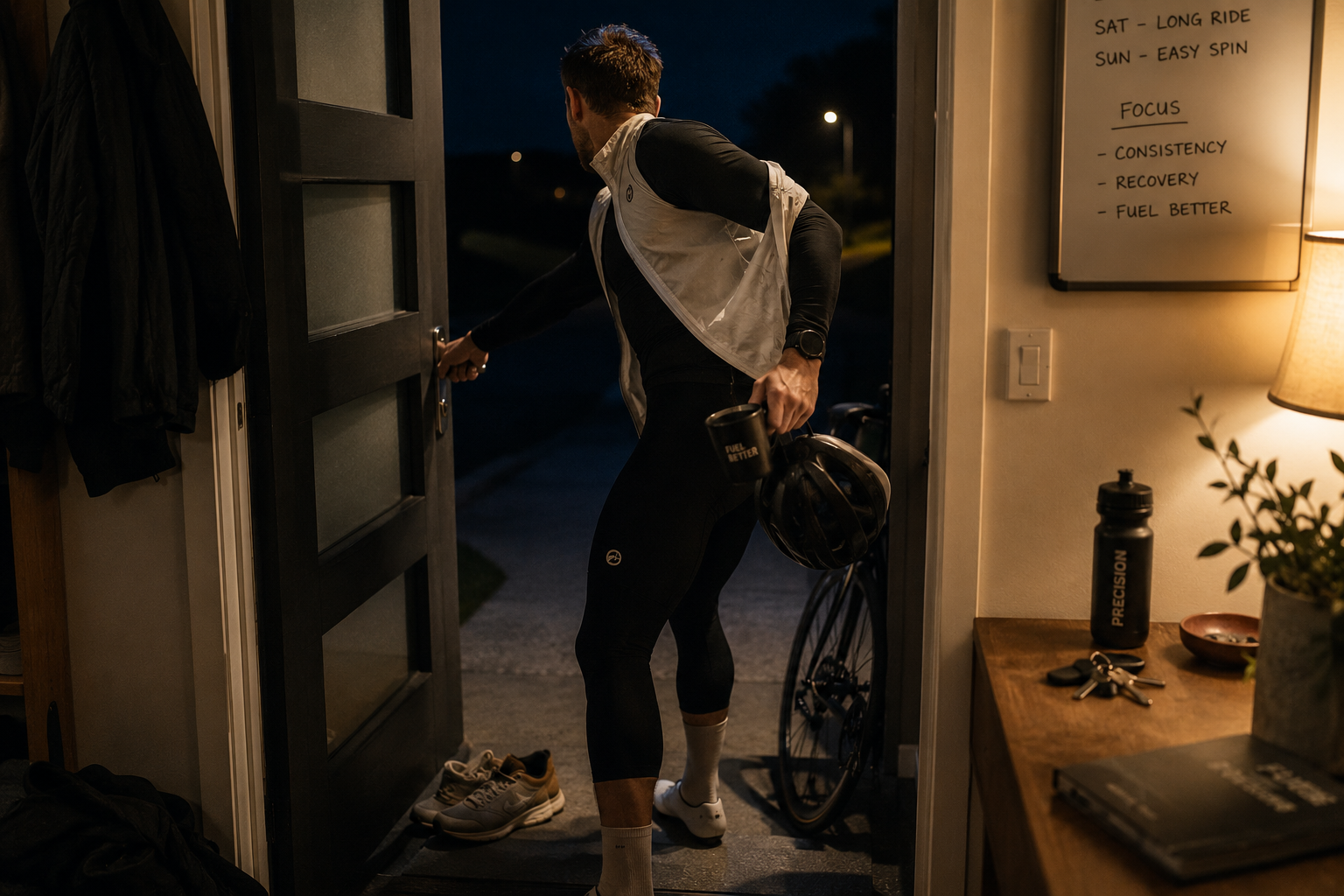
You can absolutely train for cycling on a tight schedule. You do not need endless free time, perfect mornings, or a life arranged around your rides. What you do need is a plan that fits the time you actually have and the discipline to stop pretending next week will magically be less chaotic.
For most cyclists with jobs, families, commuting, and adult admin, the key is not doing more. It is doing the right things consistently.
If your week is tight, the goal is to make your training efficient, realistic, and adaptable enough to survive normal life.
The biggest mistake busy cyclists make
When time is limited, a lot of cyclists respond by trying to cram.
They squeeze in random hard rides, make every session medium-to-hard, skip recovery, and convince themselves that exhaustion means progress. It usually does not. It usually means you are under-recovered and one bad week away from training by guilt rather than logic.
The problem is not just lack of time. It is lack of structure.
When your schedule is tight, every session matters more. That means your training needs a job, not just a slot in the calendar.
Can you get faster with limited training time?
Yes. Many cyclists improve on 4 to 6 hours per week, and plenty make strong progress on 6 to 8 hours per week, if that time is structured properly.
You can build:
- better aerobic fitness
- more repeatable power
- stronger threshold
- improved endurance
- better event readiness
The key is not chasing pro-level volume. It is using the time you do have in a way that makes sense.
A tight schedule does not stop progress. But it does punish waffle.
How much time do you actually need?
For most adults training around work and life, a practical weekly range looks like this:
- 3 to 4 hours per week - enough to maintain fitness and make modest gains
- 4 to 6 hours per week - enough for meaningful progress for many cyclists
- 6 to 8 hours per week - enough for strong progress if recovery is good
If you only have a few hours, that is still enough to work with. The mistake is acting like those hours are worthless unless they add up to some fantasy training camp volume.
They are not worthless. They are your training week.
What should you prioritise when time is tight?
If you cannot do everything, you need to know what matters most.
For most cyclists on a tight schedule, the priority order is:
1. One or two quality sessions
These are the sessions that drive fitness.
Depending on your goal, that might mean:
- threshold intervals
- VO2 max work
- tempo efforts
- sweet spot sessions
You do not need to do loads of these. You just need enough quality to create a training signal.
2. One longer endurance ride
If possible, use the weekend for a longer ride. This helps build aerobic fitness, durability, and event readiness.
That ride does not need to be epic. It just needs to happen regularly and serve a purpose.
3. Recovery and easy riding
This is where busy people get impatient and ruin perfectly decent training.
When time is tight, it is tempting to make every ride “count” by riding hard. That is a reliable way to make sure the important sessions are flat, messy, or skipped entirely.
Recovery is not wasted time. Recovery is what lets the rest of the week work.
What does a good cycling week look like on a busy schedule?
A realistic week for a busy cyclist might look like this:
Monday - Rest day
Tuesday - Intervals, 45 to 60 minutes
Wednesday - Easy spin, strength, or rest
Thursday - Tempo or threshold session, 45 to 75 minutes
Friday - Rest day or short recovery ride
Saturday - Long endurance ride, 2 to 3 hours
Sunday - Easy endurance ride, bunch ride, or recovery
That is enough to build real fitness.
It is not flashy. It is not “beast mode”. It is just effective. Which is sadly less marketable, but much more useful.
How do you make weekday training work?
Weekdays are where tight schedules either become manageable or completely collapse.
The best approach is usually to keep weekday sessions:
- short
- specific
- easy to start
- planned in advance
That often means 45 to 60 minute rides before work, after work, or indoors on the trainer.
If your weekday time is unreliable, indoor riding becomes especially useful. You lose less time to traffic, weather, setup, and daylight. That makes it easier to actually complete the session rather than spending half your window negotiating with reality.
Are indoor cycling workouts worth it?
Yes, especially when your schedule is tight.
Indoor training is often the best option for busy cyclists because it is:
- time-efficient
- easy to schedule
- consistent
- ideal for structured efforts
It is not the only way to train, and it should not replace all outdoor riding, but it can be the backbone of a busy week.
A 50-minute indoor interval session completed properly is far more useful than a 90-minute outdoor ride that gets interrupted, rushed, or turned into a commute with aspirations.
How do you train when your week is unpredictable?
This is where rigid plans start to become comedy.
A lot of training plans assume your week will unfold exactly as expected. That is adorable.
Real life does not work like that.
If your week is unpredictable, you need a plan that can flex without falling apart. That means identifying:
- the most important session of the week
- the session that can move
- the session that can be dropped if needed
- the minimum effective week
For example, if Tuesday gets destroyed by work, maybe Wednesday becomes the key session and the rest of the week shifts slightly. The point is to preserve the purpose of the week, not worship the original calendar.
What is the minimum effective training for cycling?
If life is especially busy, your minimum effective week might be:
- one interval session
- one endurance ride
- one easy or recovery ride
That is not ideal forever, but it is enough to maintain momentum and often enough to keep progressing modestly.
This matters because many cyclists treat imperfect weeks as lost weeks. They are not. A reduced week that still has structure is infinitely better than giving up and announcing that training will resume when life becomes reasonable.
Life is not becoming reasonable.
How do you avoid burnout on a tight schedule?
When time is short, the biggest risk is trying to do too much intensity and never recovering properly.
To avoid that:
- keep hard sessions limited
- protect at least one full rest day
- do not try to make up every missed workout
- reduce load during stressful life weeks
- fuel properly, even for short sessions
- be honest about sleep and fatigue
A tight schedule means your margin for error is smaller. That does not mean you are fragile. It means you need to train like an adult, not like someone trying to impress a spreadsheet.
How do you know if your plan fits your life?
A good plan on a tight schedule should feel challenging but doable.
Warning signs it does not fit:
- you miss key sessions every week
- you constantly reshuffle everything
- you feel behind all the time
- you are always tired
- you dread the plan more than the work
- every ride feels harder than it should
A plan that only works when work is quiet, sleep is perfect, and nobody needs anything from you is not a real plan. It is a fantasy brochure.
What matters most when time is limited?
When your schedule is tight, these matter more than total hours:
Consistency
A repeatable five-hour week beats a heroic eight-hour week you cannot sustain.
Clarity
Each session should have a purpose.
Recovery
Busy life still creates fatigue, even if it did not come from the bike.
Flexibility
The plan needs to bend without snapping.
Honesty
You need to build around the life you actually have, not the one that sounds better in your head.
Final answer: how do you train for cycling on a tight schedule?
You train for cycling on a tight schedule by keeping things simple, structured, and realistic.
For most cyclists, that means:
- one or two quality weekday sessions
- one longer ride on the weekend
- enough recovery to stay consistent
- flexibility when life gets messy
- focusing on repeatable weeks, not perfect ones
You do not need a perfect routine to get faster.
You need a system that works when life is busy, work runs late, motivation is average, and your available time looks more like scraps than clean blocks.
That is how adults actually improve.
If your schedule is tight, the answer is not a more rigid plan. It is a smarter one.
A tight schedule is a filter, not a ceiling. Streeka helps you cut the waffle, keep the sessions that matter, and stay on track when the week goes sideways.