Generic cycling training plans are useful.
There. That is the polite bit done.
A basic 8-week, 12-week or 16-week cycling plan can absolutely help you get started. It gives you structure. It tells you when to ride hard, when to ride easy, and when to stop pretending that every ride needs to become a spiritual duel with your ego.
For a lot of riders, that is already a massive upgrade.
But at some point, generic plans start to crack.
Not because they are stupid. Not because the person who wrote them is wrong. Not because you are uniquely cursed by the cycling gods.
They stop working because your life is not generic.
The problem with generic cycling training plans
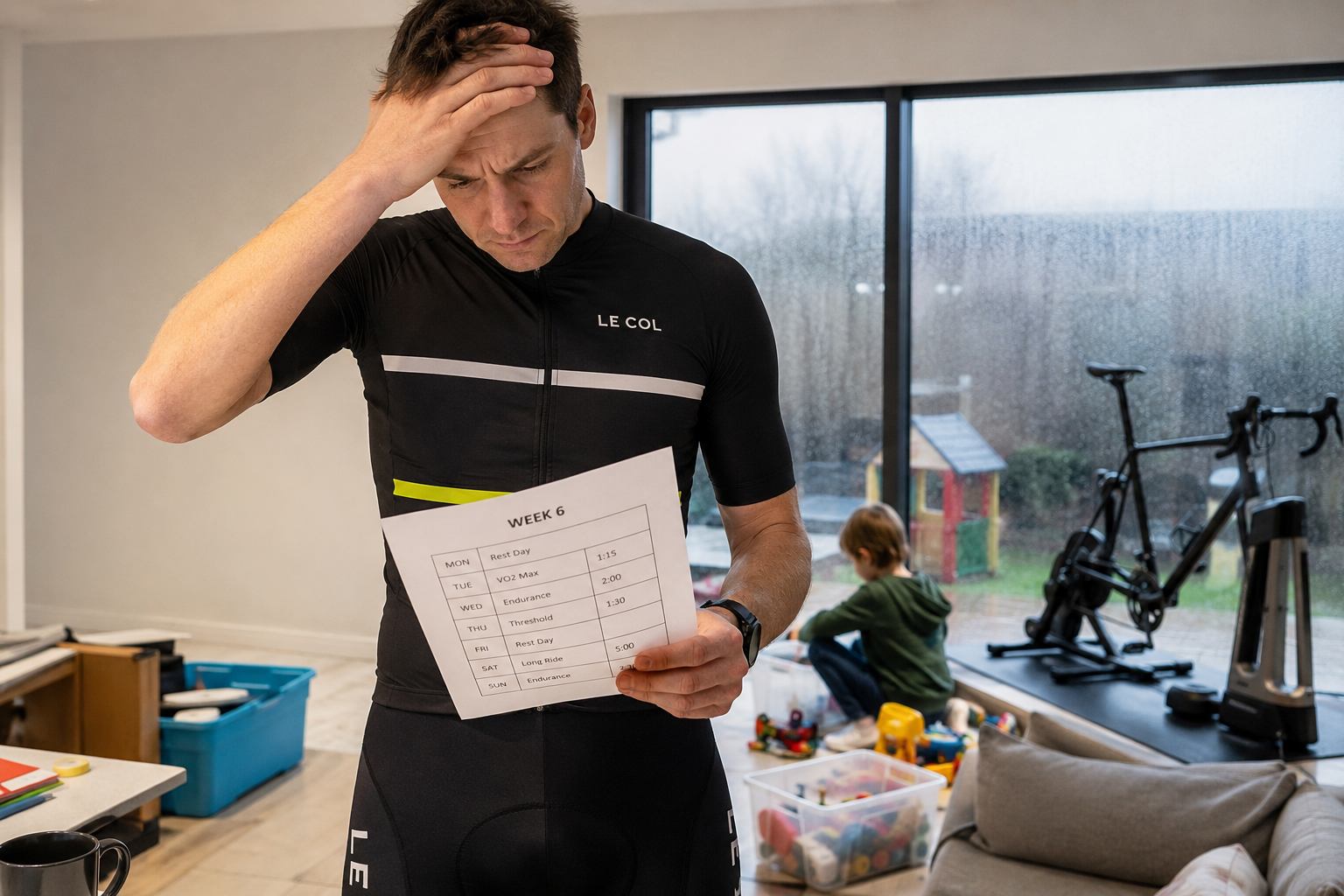
Most cycling training plans are built around a clean week.
You know the one.
Monday recovery.
Tuesday intervals.
Wednesday endurance.
Thursday threshold.
Friday rest.
Saturday long ride.
Sunday endurance or skills.
Beautiful.
Neat.
Suspiciously untouched by work calls, bad sleep, sick kids, traffic, rain, family lunches, sore legs, surprise deadlines, low motivation, or the quiet horror of being an adult with responsibilities.
The plan assumes that your body and your calendar are both available for instruction.
Real life does not care.
A generic plan might say Tuesday is VO2 max day.
But what if Tuesday is the day you slept five hours, had back-to-back meetings, forgot to eat properly, and only got on the trainer at 8:47pm with the enthusiasm of a damp sock?
The workout might still be “right” on paper.
It may not be right for you that day.
That is where the wheels start to wobble.
Generic plans are static. You are not.
A static training plan is a prediction.
It predicts what you will be able to do next week. And the week after. And the week after that.
That prediction might be useful at the start. But the longer the plan runs, the more reality gets involved.
You might:
- miss a key session
- smash a ride harder than planned
- get sick
- travel
- under-fuel a long ride
- sleep badly for three nights
- feel amazing and overdo it
- feel terrible and panic
- complete the work but carry more fatigue than expected
A static plan usually has no idea any of this happened.
It just keeps marching forward like a tiny spreadsheet dictator.
That can create two common problems.
First, the plan becomes too hard. You carry fatigue into sessions, start failing workouts, lose confidence, and assume you are not fit enough.
Second, the plan becomes too easy. You adapt faster than expected, keep repeating work that no longer challenges you, and wonder why your fitness has stopped moving.
Both are frustrating.
Both are common.
And neither means you are bad at training.
It means the system is not listening.
Missing one session should not ruin the week
One of the biggest problems with generic plans is what happens when you miss a workout.
Most riders do one of three things.
They skip it completely and feel guilty.
They cram it into the next day and accidentally create a fatigue sandwich.
Or they try to “catch up” by stacking sessions together, because apparently humans saw training stress and thought: what if we made this administratively worse?
This is where a lot of self-coached riders get into trouble.
The missed session is rarely the real problem.
The reaction to the missed session is the problem.
If you miss Tuesday intervals, the answer is not always “do them Wednesday”.
Maybe Wednesday was meant to be endurance because Thursday is already hard. Maybe the better move is to shift the week around. Maybe the intensity should be reduced. Maybe the session no longer matters because the purpose of the week has changed.
A good training system does not just ask, “What workout did you miss?”
It asks, “What are we trying to achieve this week now?”
That is a completely different question.
A plan is only useful if it fits the rider
Cycling training is not just about sessions.
It is about the relationship between the work, the rider, and the life around the rider.
A good plan considers:
- your current fitness
- your available time
- your recent training load
- your recovery
- your goal
- your strengths and weaknesses
- how consistent you have actually been
- what kind of riding you are preparing for
- how much stress your life is throwing at you
A generic plan can guess some of that.
It cannot truly respond to all of it.
That matters because two riders can follow the same plan and get very different outcomes.
One rider might absorb three hard sessions a week beautifully.
Another might need two hard sessions, more endurance, and better recovery.
One rider might thrive on long sweet spot work.
Another might get stale, tired, and weirdly angry at their bike computer.
Same plan. Different athletes. Different lives.
This is why “just follow the plan” sounds simple, but often fails in practice.
The best cycling plan is not the hardest one
A lot of riders judge training plans by how impressive they look.
Big sessions. Big hours. Big numbers. Big delusion in Lycra.
But the best plan is not the one that looks most serious.
The best plan is the one you can actually absorb.
That word matters: absorb.
Training only works if your body can adapt to it. The workout itself is just the signal. The improvement happens afterwards, when you recover, refuel, sleep, and come back ready for more.
If the plan keeps asking for work you cannot absorb, it is not making you tougher.
It is making you tired.
There is a difference.
You do not get faster by collecting failed sessions.
You get faster by applying the right stress at the right time, recovering enough to adapt, and repeating that process consistently.
Annoyingly unsexy.
Deeply effective.
What adaptive training does differently
Adaptive training changes the role of the plan.
Instead of treating the plan as a fixed set of instructions, it treats it as a living system.
The goal stays the same.
The route can change.
That means your training can respond when:
- you miss a workout
- you complete a session better than expected
- your fatigue is higher than planned
- your available time changes
- your recent rides suggest a different focus
- your goal needs a smarter progression
This does not mean every day becomes random.
Actually, it should mean the opposite.
Good adaptive training gives you more structure, not less.
It keeps the intent of the plan intact while adjusting the details around real life.
That is the bit most riders need.
Not chaos.
Not vibes.
Not “just listen to your body”, which is often terrible advice if your body mostly says coffee, pastry, and new wheels.
You need a plan with a brain.
When a generic cycling plan is still useful
Generic plans are not useless.
They can be a good fit if:
- you are new to structured training
- you have a simple goal
- your schedule is predictable
- you recover well
- you are not trying to optimise too much yet
- you mainly need consistency
For many riders, a generic plan is the first step away from random riding.
That is a good thing.
Random riding can be fun, but it often creates random results.
The issue is what happens when your goals get more specific, your time gets tighter, or your life gets messier.
That is when you start needing more than a calendar full of workouts.
You need decisions.
Signs your current plan is not fitting anymore
Your cycling training plan might not be working if:
- you keep failing key workouts
- you are always tired but not improving
- you miss sessions and do not know how to adjust
- your easy rides keep becoming hard rides
- your hard rides feel impossible
- your fitness has plateaued
- you are training more but feeling worse
- the plan does not reflect your real available time
- you feel guilty more often than you feel clear
That last one is worth noticing.
A good plan should create clarity.
Not guilt.
There will always be hard days. There will always be sessions that make you question your choices, your bike fit, and your entire personality.
But the plan should help you understand what to do next.
If it just makes you feel behind all the time, something is off.
Structure should make training feel calmer
This is the strange part.
Good structure should not make your life feel more rigid.
It should make it feel calmer.
When the plan fits, you stop guessing.
You know why today’s session exists. You know what to do if things change. You know when to push and when to back off. You stop treating every missed workout like a moral failure.
That is the real value of structured training.
Not more suffering.
Better decisions.
Because most busy cyclists do not need a perfect plan.
They need a plan that survives contact with Tuesday.
The real goal: consistency without pretending life is clean
For adult cyclists, consistency is rarely about motivation.
It is about design.
You need training that fits around work, fatigue, family, weather, social life, travel, and all the other nonsense that keeps appearing because apparently being alive comes with admin.
The riders who improve are not always the ones with the most time.
They are the ones who can keep adapting without losing the thread.
That is why generic plans eventually hit a ceiling.
They can tell you what a good week looks like.
But they struggle when your actual week does not look like that.
And for most riders, that is most weeks.
Generic cycling plans are a good starting point.
But if you are training for a real goal, with a real life, you eventually need more than a static calendar.
You need a system that understands what you did, what you missed, how you are responding, and what should happen next.
That is the difference between following a plan and actually training.
One gives you workouts.
The other gives you direction.
And if you are trying to get faster while also having a job, a life, and possibly a mortgage with better endurance than you, direction matters.
One gives you workouts. The other gives you direction. Streeka gives you direction.